What is MagnaPlast?
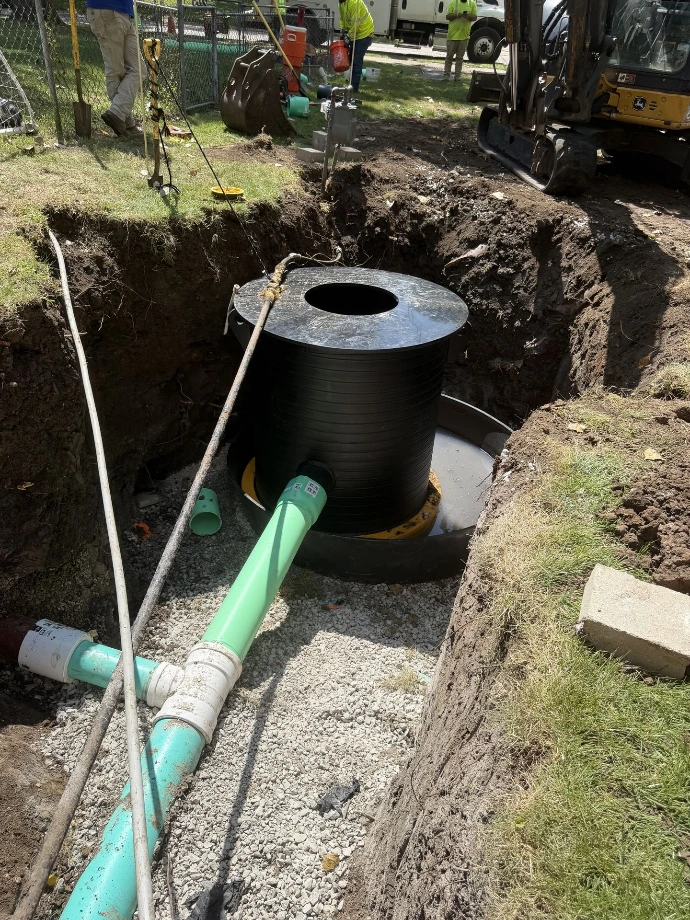
Each project-specific system integrates the barrel, base and flow channel, pipe interfaces, adjustable riser, access components, and anti-flotation features where required. Delivered as one coordinated assembly—not a collection of separate field-assembled components—MagnaPlast™ is designed to help reduce corrosion exposure, leak paths, installation complexity, and long-term maintenance burden.
THE MAGNAPLAST™ SYSTEM
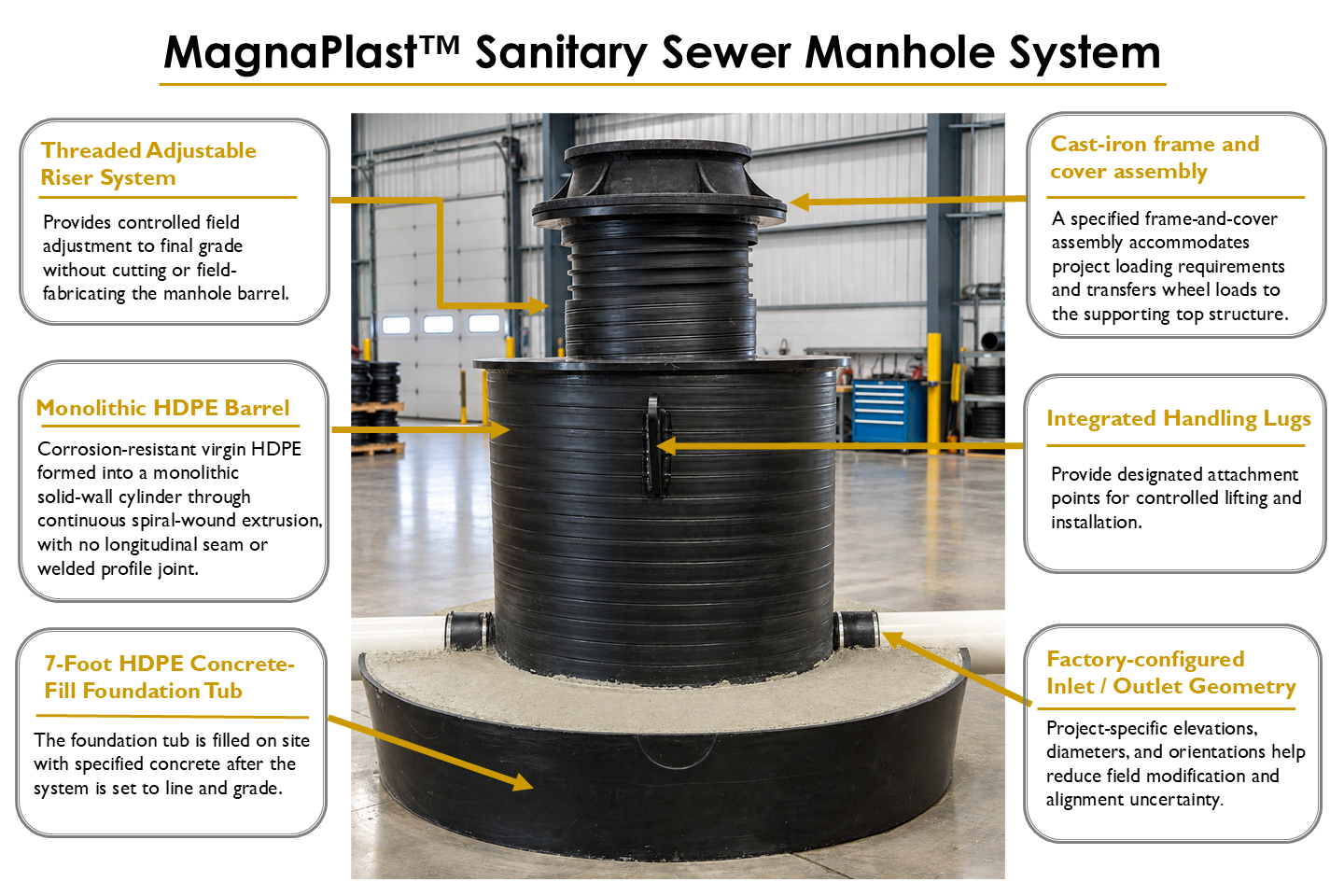
MagnaPlast™ system shown with the foundation tub filled inside the factory for demonstration purposes. For project installations, the tub is delivered unfilled and filled on site with specified concrete after the system is set to line and grade.
The MagnaPlast manhole barrel is manufactured from corrosion-resistant virgin HDPE with incorporated carbon black and continuously spiral-wound into a monolithic, solid-wall cylinder.
Available manhole diameters include 4, 5.5, 7, 7.8, 9, 11, and 13 feet, with overall structure depths generally available from 2 to 40 feet, depending on project requirements. The barrel is produced with a uniform wall thickness ranging from approximately 0.75 to 2 inches, as specified for the application.
A specified cast-iron frame-and-cover assembly provides the finished access point at grade and transfers wheel loads to the supporting top structure. MagnaPlast can be configured with direct-mount or grade-ring access arrangements, depending on the project design.
Frame-and-cover options are selected to meet specified traffic and loading requirements, including H-20/HS-20 or H-25/HS-25 configurations where required. The final access and cover configuration should be determined by the engineer of record and the applicable owner or municipal standard.
The threaded adjustable riser system provides controlled field adjustment to final grade without cutting or field-fabricating the manhole barrel. This allows the installed access elevation to be refined during construction while preserving the integrity of the monolithic barrel.
Available riser options include 24-, 27-, and 30-inch diameters, with up to 9 inches of vertical adjustment. Final riser selection and grade adjustment should be coordinated with the project’s access, cover, traffic-loading, and installation requirements.
Integrated handling lugs provide designated attachment points for controlled lifting, setting, and installation of the factory-assembled MagnaPlast system. They support more deliberate handling of the complete manhole assembly from delivery through placement.
Lifting methods, rigging, equipment capacity, and field safety procedures must be appropriate for the delivered system’s final size, weight, configuration, and site conditions. Contractors should follow Houston PolyTank installation guidance and all applicable jobsite safety requirements.
Inlet and outlet connections are factory configured around the project’s specified pipe sizes, elevations, orientations, and hydraulic requirements. This helps reduce field modification and alignment uncertainty during installation.
Standard configurations can accommodate up to five inlets, with additional connections available where supported by project-specific engineering. The system may also be configured with a 24-inch minimum manway opening, or a larger opening as specified, and project-appropriate channel geometry and cross-slope requirements.
Dual Stage Anti-Flotation Foundation
MagnaPlast™ combines a factory-filled, HDPE-encapsulated rotomolded base with a separate 7-foot HDPE concrete-fill foundation tub. The base is incorporated into the factory-assembled manhole before delivery; the foundation tub is filled on site after the complete assembly is set to line and grade.
Together, these components form the dual-stage foundation, configured for project-specific groundwater, buoyancy, and structural requirements.
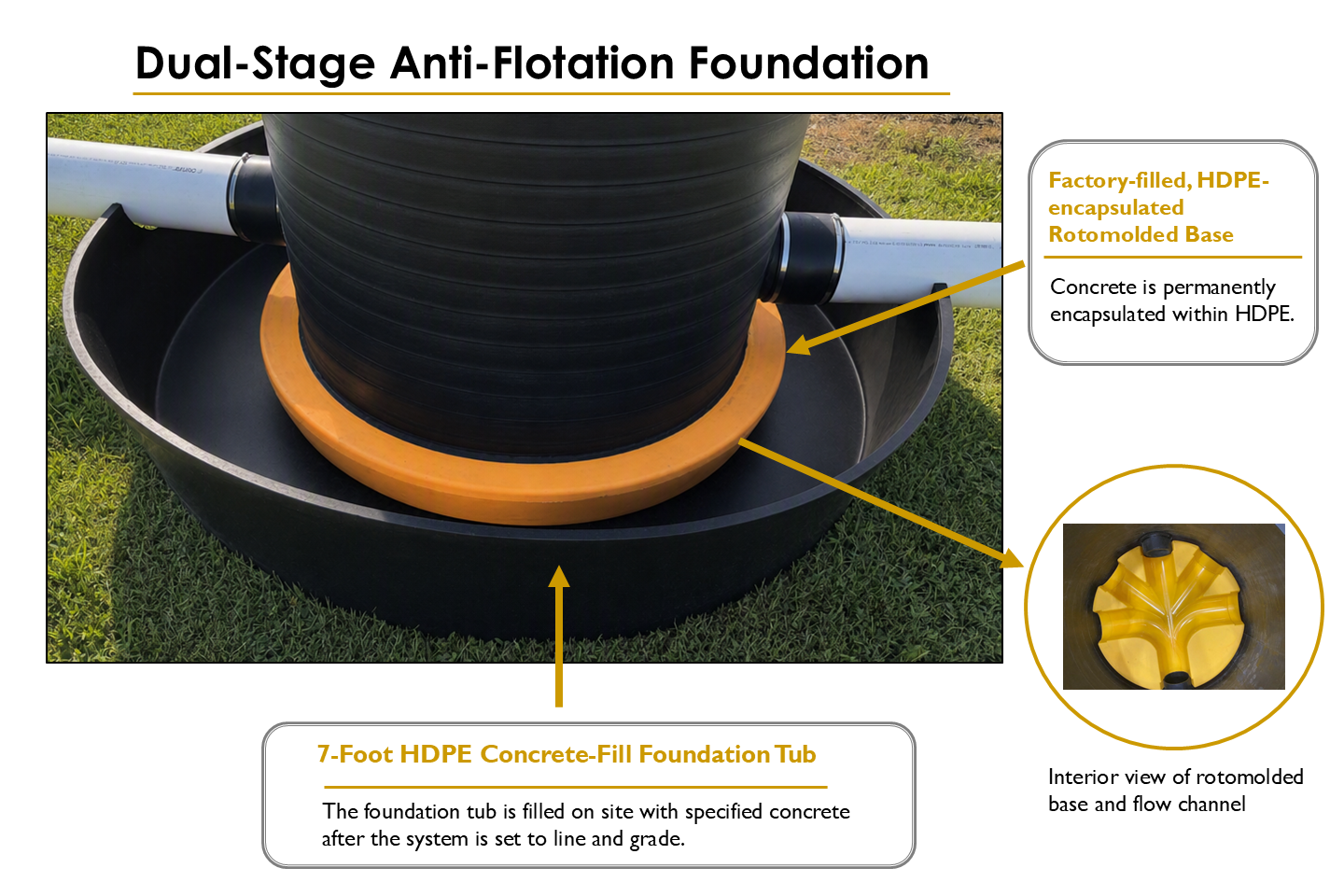
The rotomolded HDPE base is filled with concrete at the factory and incorporated into the complete manhole assembly before delivery. The concrete is permanently encapsulated within HDPE and isolated from the wastewater.
The flat-bottom base includes structural gussets and a project-configured flow channel to support wastewater-flow and structural requirements. It forms the factory-filled component of MagnaPlast’s dual-stage anti-flotation foundation.subject to project-specific engineering, loading conditions, groundwater conditions, pipe connections, burial depth, and installation details.
The separate 7-foot HDPE foundation tub surrounds the base of the complete manhole assembly. After the assembly is set within the tub to line and grade, the tub is filled on site with specified concrete.
The field-filled tub works with the factory-filled, HDPE-encapsulated base to help resist groundwater-driven uplift and lateral movement, subject to project-specific engineering.
MagnaPlast™ is a trademark of Houston PolyTank, LLC. MagnaPlast™ and its integrated Anti-Flotation System incorporate proprietary structural and manufacturing features that are patent pending under U.S. Patent Application No. 63/789,260.
Repair, Rehabilitate, or Replace?
Repair or rehabilitation may be appropriate when the existing structure remains sound. When deterioration, recurring leakage, corrosion exposure, or maintenance demands indicate a broader problem, evaluate whether replacement better addresses the underlying conditions.
For projects targeting infiltration and inflow (I&I), evaluation should address the complete installed manhole—including pipe connections, access interfaces, and covers—not the barrel alone.
MagnaPlast™ is a complete, factory-assembled, monolithic HDPE manhole system—not a coating or liner applied to an existing structure. It provides a project-configured solution when replacement is the appropriate approach.
The comparison below highlights differences in construction, installation, and maintenance considerations to support project-specific evaluation.
Compare the System Approach—Not Only the Material
Compare MagnaPlast’s factory-assembled HDPE system with precast concrete and field-applied rehabilitation approaches across corrosion protection, connection details, foundation requirements, installation work, and ongoing maintenance.
 Comparison
note:
This chart summarizes general system characteristics. Final system
selection, structural design, corrosion-control requirements,
groundwater and buoyancy design, installation practices, testing, and
acceptance criteria must be determined by the engineer of record and
applicable project specifications.
Download the Manhole Comparison Chart
APPLICATIONS
MagnaPlast™ is engineered for the environments where concrete and polymeric concrete consistently fail. Its monolithic HDPE construction, corrosion‑proof performance, and factory‑assembled reliability make it ideal for municipal, industrial, and high‑risk wastewater applications.
Municipal Wastewater Systems
Sanitary sewer collection systems; gravity sewer networks; interceptor and trunk lines; project-specific lift-station transitions; replacement of deteriorated manholes
Urban Development & Roadway Projects
New residential and commercial developments; urban redevelopment; streets and intersections; roadway reconstruction; projects with constrained access or construction schedules
Food & Meat Processing
Food-production facilities; meat and poultry processors; associated sanitary and process-wastewater collection systems, subject to application-specific review
Industrial & Process Wastewater
Biotechnology and fermentation; chemical manufacturing; petroleum and refining; mining; steel and metals processing, subject to waste-stream and project-specific
Conditions to Evaluate
Project evaluation considers corrosion exposure, groundwater and buoyancy, soil and backfill conditions, traffic loading, connection geometry, and construction constraints.
Industrial applications also require review of wastewater constituents, concentrations, temperatures, and cleaning chemicals.
Where hydrogen sulfide (H₂S) and associated sulfuric-acid corrosion contribute to manhole deterioration, evaluate material suitability alongside wastewater characteristics, structural loading, and installation conditions.
TECHNICAL DETAILS & DESIGN CONSIDERATIONS
2 ft. to 40 ft., subject to project-specific engineering and configuration.
Project-configured
inlet and outlet locations, elevations, diameters, and orientations.
Standard configurations accommodate up to five inlets; additional
connections may be available based on project-specific engineering.
24-,
27-, and 30-in. riser options; up to 9 in. of vertical adjustment.
Direct-mount
or grade-ring access configurations for specified frames, covers, and
traffic-loading requirements, including H-20/HS-20 or H-25/HS-25
where specified.

MagnaPlast manholes in assorted heights
(click to enlarge image)
INSTALLATION & INTEGRATION
Move More Coordination Ahead of Construction
Replacing or installing a manhole requires more than selecting a structure. Utility operators, engineers, and contractors must coordinate pipe connections, groundwater conditions, access elevations, foundation requirements, and the work needed to return the site to service.
MagnaPlast™ brings component fabrication and configuration into the factory before delivery. The project-configured assembly helps reduce separate field-assembly tasks while leaving the installation team with a defined scope of site preparation, placement, connections, foundation completion, backfill, and testing.
Installation must follow approved project drawings, Houston PolyTank instructions, and applicable owner specifications. Requirements are coordinated with the project’s HDPE manhole design basis and applicable ASTM D2321 backfill-material principles. Excavation support, bypass pumping, groundwater control, lifting equipment, foundation requirements, and restoration are determined by site conditions.
What Arrives and What Remains
The delivered manhole assembly incorporates the HDPE barrel, factory-filled encapsulated base, configured inlet and outlet connections, and specified access components. The separate HDPE foundation tub receives its concrete fill on site after the assembly is positioned to line and grade.
Field work remains essential to installed performance. Project drawings and Houston PolyTank’s installation instructions establish requirements for:
- Excavation, groundwater control, bedding, and foundation preparation.
- Lifting, placement, and verification of line and grade.
- Pipe connections and specified foundation concrete placement.
- Backfill, compaction, and final access adjustment.
- Required inspection, testing, and acceptance.
This distinction helps project teams evaluate the actual construction workflow—not simply the delivered product.
Maintenance & Ownership Considerations
For owners facing recurring corrosion-related rehabilitation, the maintenance question is not whether a manhole needs attention; it is which recurring tasks the selected system requires.
The MagnaPlast™ HDPE barrel does not depend on a separate field-applied protective coating or liner. Its corrosion protection therefore does not require renewal of that separate barrier. Routine stewardship still includes inspection of the installed structure, pipe connections, flow channel, access components, and surrounding grade, together with cleaning and corrective work as conditions warrant.
Owners should incorporate MagnaPlast into their existing collection-system inspection and asset-management program. Cleaning methods and equipment must follow manufacturer-approved procedures. The objective is to reduce dependence on recurring protective-layer rehabilitation while retaining responsible inspection and maintenance of the complete installation.
ENGINEERING SUPPORT & PROJECT EVALUATION
MagnaPlast™ is backed by project-specific engineering support to help consulting engineers, utility owners, municipalities, and industrial owners evaluate, detail, and specify complete manhole solutions.
Engineering Resources & Deliverables
- Project-specific submittal packages: Dimensioned drawings documenting proposed structure geometry, inlet/outlet elevations, connection diameters, and deflection angles.
- Structural and buoyancy analysis: Calculations addressing anti-flotation ballast, groundwater head, burial depth, and specified traffic loading.
- Specification support: CSI-formatted performance specifications and pipe-interface detailing.
- Installation and backfill coordination: Guidance on excavation, bedding, foundation concrete placement, and backfill compaction.
Professional Collaboration
MagnaPlast™ is engineered in collaboration with strategic partner Dan Early, P.E., of Infrastructure Dynamics, bringing thermoplastic system and structural-design expertise to municipal water and wastewater applications.
CONTACT OUR ENGINEERS
Ready to Evaluate a Replacement or New-Construction Project?
MagnaPlast™ offers engineers and utility owners a complete manhole system to evaluate for projects involving corrosion exposure, recurring rehabilitation, or new construction.
Houston PolyTank provides project-specific configuration reviews, custom submittal drawings, and engineering calculations. For your team, an engineer-led technical briefing covers monolithic HDPE manhole design, structural design criteria, buoyancy calculations, and field installation practices.
Call: (660)-301-2015 or request a technical review, design consultation, or team briefing.
For project pricing, request a MagnaPlast™ manhole quote.